- Strait of Hormuz 'A Bridge too Far'
- Red Card sensation
- US Postal Service to become Charles III Post Office (C3PO)
- Indie Band Vampire Weekend proscribed for terrorism
- Captain Commonwealth joins MAGBA
- EU to join UK shock!
- Tender process announced for Rushmore redevelopment
- Lord John Marbury mercy dash
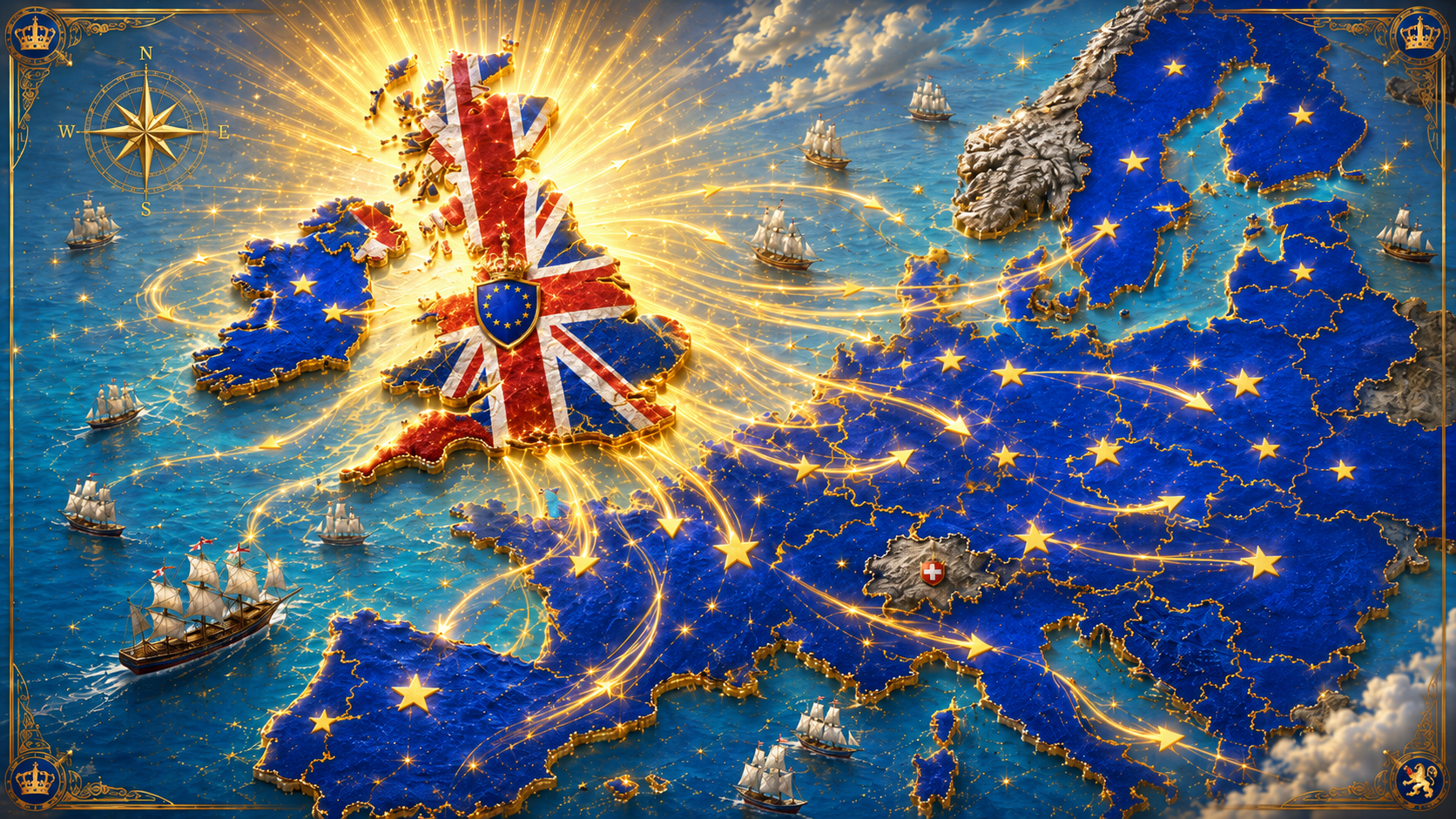
Breaking News
Eurentry
EU to join UK
After years of negotiations, elections, treaties, protocols, frameworks, rows, resets, sandwiches, and people saying “frictionless” without any visible sign of shame, Europe has agreed in principle to join the United Kingdom.
The Office of the Commissioner is pleased to confirm that negotiations have entered their final phase for the accession of the European Union to the United Kingdom, under the historic process now formally known as Eurentry.
Eurentry is, naturally, the opposite of Brexit. Brexit involved the United Kingdom attempting to leave Europe while remaining beside it, trading with it, holidaying in it, arguing with it, relying upon it, and occasionally pretending not to know it. Eurentry resolves these difficulties by allowing Europe to join Britain instead.
This is not a reversal of Brexit. On the contrary, it is the fullest possible implementation of it. The British people voted to leave the European Union. They did not vote to prevent the European Union subsequently applying to join them.
The proposal was first raised informally by German officials in the 1960s after President Charles de Gaulle repeatedly said non to British membership of the European Economic Community.
Contrary to popular memory, this irritated the Germans considerably more than it irritated Britain. The British response was chiefly to make another pot of tea and enquire whether anyone had considered the Commonwealth. German officials, meanwhile, began the long process of examining whether France could be administratively bypassed.
The idea remained dormant for several decades because Europe was functioning comparatively well, Britain had other things to complain about, and nobody had yet invented a customs declaration containing 54 mandatory fields for the movement of a ham sandwich.
Brexit finally reaches its logical conclusion
The failure of successive governments to reconcile Brexit with geography has now brought the matter to a head.
Britain cannot move farther away from France without inconveniencing Cornwall. Ireland cannot be divided without breaching the Good Friday Agreement. It cannot be left undivided without troubling customs officials. It cannot remain simultaneously inside and outside the European Union without several lawyers beginning to glow.
Eurentry provides the first solution that respects the Brexit vote, the Good Friday Agreement, the constitutional integrity of the United Kingdom, the European single market, the existence of Ireland, and the continuing availability of decent cheese.
The Commissioner accepts that some commentators may disagree. They are invited to submit a logically consistent alternative by close of business on Friday. Anyone unable to do so but still holding an anti-Eurentry position will be labelled a terrorist and have queueing privileges removed.
This is not intended as intimidation. It is simply important that public debate remains evidence-based.
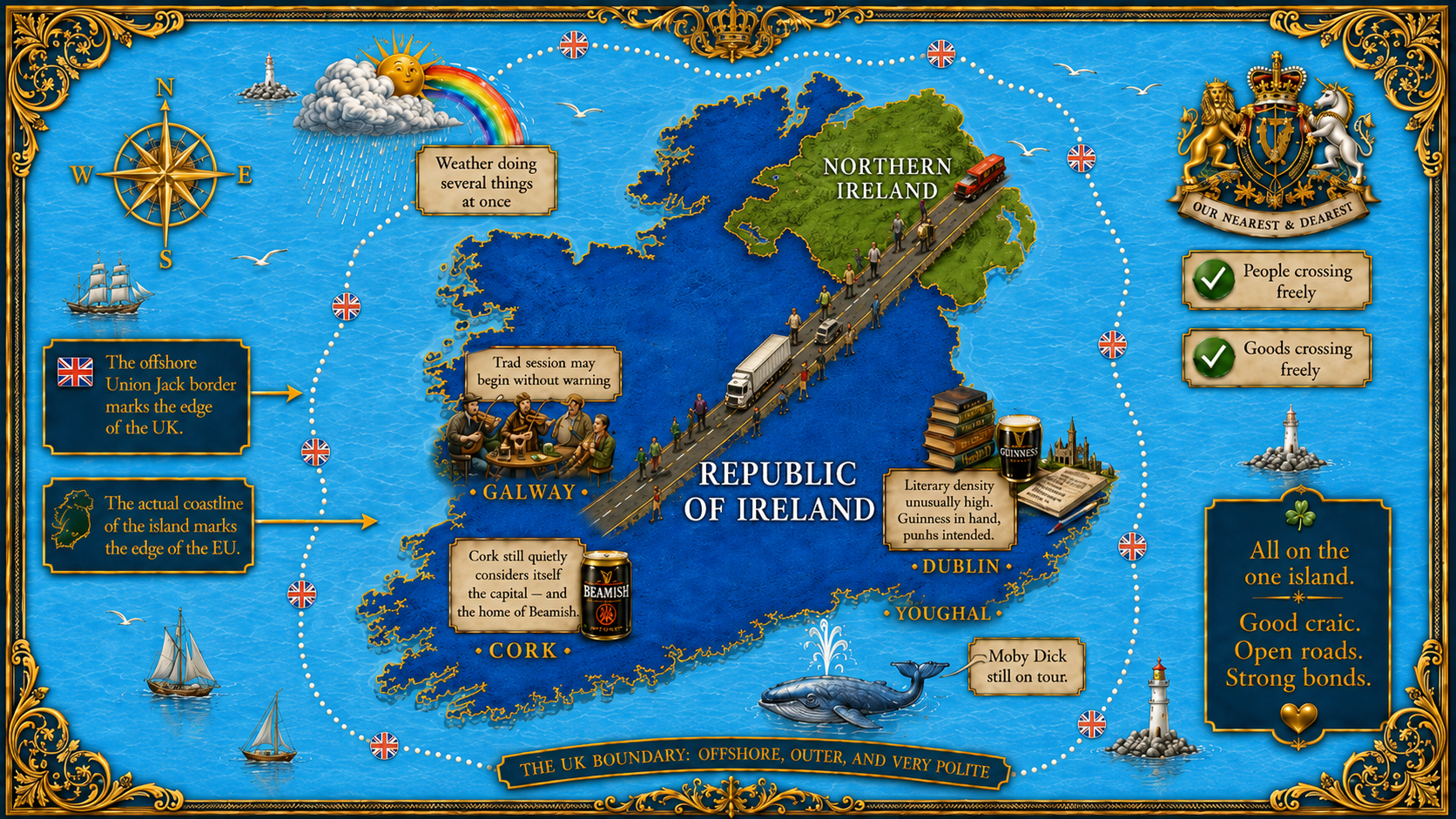
The Irish question, answered politely
The accompanying map demonstrates the elegance of the arrangement.
Northern Ireland remains in the United Kingdom. The Republic of Ireland remains in the European Union. The European Union is inside the United Kingdom. The whole island is, therefore, simultaneously protected by the Good Friday Agreement, Brexit, EU law, British constitutional practice, and an offshore boundary marked at tasteful intervals by the Union Jack.
People and goods will cross the internal Irish border freely. One lorry may proceed north-east. Another may proceed south-west along the newly completed Belfast–Cork Royal Motorway, whose construction appears to have taken place overnight and without planning permission.
No checks will be required at the land border because it is an internal United Kingdom border. No checks will be required at the coastline because it is the edge of the European Union. Any official still requesting paperwork will be asked to stand quietly between the two boundaries until the constitutional position becomes clear.
Dublin will retain its exceptional literary density and access to Guinness. Cork will continue to regard itself as the capital, while insisting upon Beamish as a matter of local sovereignty. Traditional music sessions may commence without warning, particularly in Galway, and the national weather settlement will continue to permit sunshine, rain, cloud, and a rainbow to occur within the same ten-minute period.
Youghal will receive specific protection for its historic association with Moby Dick. The whale itself is understood to have welcomed Eurentry, although marine legal experts remain divided on whether it will require settled status.
Transition negotiations intensify
Although all major governments are now aligned on the principle of Eurentry, discussions continue over the transition arrangements.
The principal remaining disagreement
Germany is demanding that the official use of French cease at 11.00 p.m. on the first day of transition.
The British delegation has taken a more liberal position, suggesting that French might continue during an orderly eighteen-month wind-down period, particularly in restaurants, ballet, diplomacy, and situations involving unusually small cups of coffee.
German negotiators are reported to be digging in hard. One source close to the talks said Berlin had waited since 1963 for this moment and was “not about to lose it over the word croissant”.
France has objected that French is a language of international diplomacy. Germany has replied that this is precisely the problem.
Britain has offered a compromise under which French may continue to be spoken privately, provided that all public nouns are accompanied by a plain-English explanation and nobody pretends that entrée means the main course.
Other transition matters are proving less contentious. Spain has requested continued access to British tourists while reserving the right to complain about them. Italy has sought an exemption for coffee. Belgium has asked whether anyone remembers that Brussels is the capital of Europe. The Commissioner has confirmed that this will be reviewed in due course.
A larger, calmer Europe
Following Eurentry, the European Commission will become the European County Council, subject to routine inspection by Ofsted and an annual village fête.
The European Parliament will continue to meet in Brussels, except during those weeks when it moves to Strasbourg for reasons nobody has ever successfully explained. Under the new constitutional settlement, this will be classified as heritage re-enactment.
The euro will remain legal tender, although all amounts must also be displayed in pounds, shillings, pence, and a rough estimate of how many pints the sum would have purchased in 1974.
The Schengen Area will be retained but renamed the Queueing Preparation Zone. Freedom of movement will continue, provided that travellers approach in an orderly manner, apologise when bumped into, and understand that putting a towel on a sunbed does not create a legally enforceable interest in land.
The Commissioner emphasised that Eurentry should not be mistaken for British expansionism.
“Expansionism,” he explained, “involves acquiring territory without being asked. This is simply Europe arriving at the correct answer after a regrettably long consultation exercise.”
Ratification is expected shortly after the remaining governments have formally denied that negotiations are taking place.
Further details will be published once Germany and France have agreed what language to use in the announcement.