- Strait of Hormuz 'A Bridge too Far'
- Red Card sensation
- US Postal Service to become Charles III Post Office (C3PO)
- Indie Band Vampire Weekend proscribed for terrorism
- Captain Commonwealth joins MAGBA
- EU to join UK shock!
- Tender process announced for Rushmore redevelopment
- Lord John Marbury mercy dash

Buckingham Palace confirms that His Majesty is ready to open whatever needs opening, drawing upon almost a thousand years of accumulated national experience.
OFFICE OF THE COMMISSIONER • LONDON
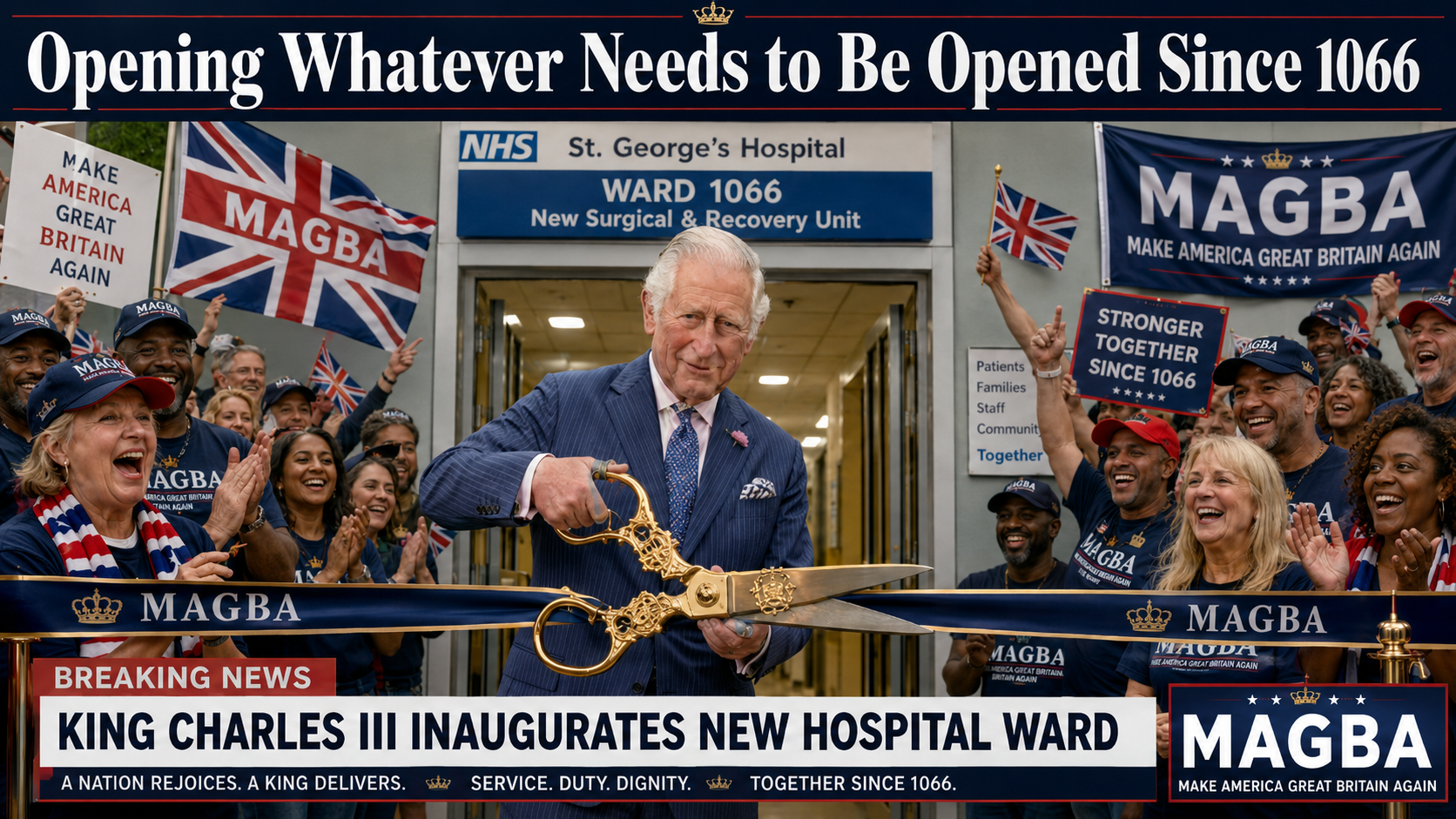
King Charles III has formally returned to front-line opening duties, cutting the ribbon on a new hospital ward with the calm authority of a monarch representing a nation that has been opening things professionally since 1066.
Witnesses described the ceremony as a masterclass in constitutional scissor work. His Majesty inspected the ribbon, assessed the prevailing wind, acknowledged the assembled dignitaries, and completed the cut cleanly at the first attempt.
The ornate ceremonial scissors, believed to have been used previously for the opening of several bridges, two railway stations, a municipal conservatory, and possibly India, were handled with characteristic precision.
The ceremony has renewed debate about whether relatively young countries should attempt major openings without appropriate supervision.
MAGBA officials stressed that nations less than three hundred years old should not feel embarrassed by their comparative lack of experience. There remain many useful opportunities for junior countries to practise in a controlled environment.
County fairs, shopping malls, garden centres, local car dealerships, and moderately important envelopes were all identified as suitable developmental openings.
“Everyone has to start somewhere,” said one senior MAGBA adviser. “There is no shame in opening a regional craft festival or a new branch of a doughnut chain. Confidence comes gradually.”
More strategically important openings, however, are expected to remain under British control.
These include major sporting events, parliamentary sessions, global summits, historic buildings, difficult jars, and international waterways whose closure might cause a sudden rise in the price of almost everything.
Particular concern has been expressed about the Strait of Hormuz, which officials agree should only ever be opened by a country with substantial experience, a plan for what happens after opening, and access to ceremonial scissors of an appropriate scale.
“The Olympic Games cannot simply be opened by someone walking onto a stage and shouting, ‘Let’s get started,’” the adviser added. “Nor should the Strait of Hormuz be approached with a pair of kitchen scissors and misplaced optimism.”
Britain’s expertise in opening things has developed over centuries. Monarchs have opened hospitals, schools, roads, bridges, exhibitions, factories, museums, airports, canals, garden fêtes, village halls, and buildings that were already officially opened by another member of the Royal Family.
The practice combines diplomacy, engineering awareness, public service, and the ability to appear deeply interested in a commemorative plaque while several hundred people take photographs.
King Charles is understood to have trained extensively for the role, beginning with envelopes and breakfast marmalade before progressing to curtains, plaques, and ribbon-based infrastructure.
His technique is said to favour a measured two-handed approach, followed by a slight royal smile and an immediate conversation with whoever has been waiting longest in the rain.
Under MAGBA’s reunification proposals, the United States would receive full access to Britain’s accumulated opening expertise.
A phased training programme would begin with supervised envelopes and advance through supermarkets, state fairs, and suburban leisure facilities. Successful candidates might eventually be permitted to open a railway station, provided that a suitably experienced British person remained nearby.
Large-scale openings would continue to require royal approval during the transition period.
The White House would also be encouraged to replace the phrase “grand opening” with the more constitutionally responsible “opening in the presence of somebody who knows what they are doing”.
Following the ceremony, hospital representatives confirmed that the new ward was fully operational, properly inspected, and considerably more open than it had been that morning.
His Majesty then met patients, families, and staff before departing for another engagement believed to involve a plaque, a curtain, and a building that has technically been open since February.
MAGBA has reassured the public that the King remains available for all openings of national or international significance.
Lesser openings should continue to be referred to local authorities, shopping-centre managers, or Americans undergoing basic training.